Skip to content

Being-Centred Living - Be More by doing less!

Connect with the essence of confidence, vitality, peace, kindness, joy, freedom and love by recognising and relinquishing any counterproductive ways you may be seeking these states.

We are often so busy doing things that we miss the simple enjoyment of being in life.

We do much of what we do because we hope to get certain feelings that are precious to us, such as the feeling of confidence, vitality, peace, kindness, joy, freedom and love. 

Ironically enough, when we allow ourselves to simply be, we find that the present moment holds all the feelings we seek, and that we are simply too busy seeking to notice this. 

In Being-Centred Living, you will be guided through a systematic and rigorous exploration into the essence of what you seek. You will learn to see and unhook from your counterproductive habits and to connect directly with what you seek in the present moment.

What students typically get from the course

  • A profound sense of self-love and wholeness
  • Increased tolerance, love and empathy for partners, children, friends, and colleagues
  • Increased capacity to enjoy life as it is which makes your life both simpler and richer
  • Courage to feel your vitality and passion and let it guide you in life
  • Healing and resolution for issues you have struggled with throughout life
  • Increased capacity to help clients and to resolve both intrapersonal and interpersonal conflicts with less drama
  • Better understanding of other spiritual teachings you may have encountered

Each session will contain a mix of

  • guided meditations
  • Theoretical presentations based on time-honoured spiritual traditions as well as from modern research in cognitive science and positive psychology.
  • self-inquiry exercises
  • Q&A sessions where students can work directly with the teacher. 

The practices

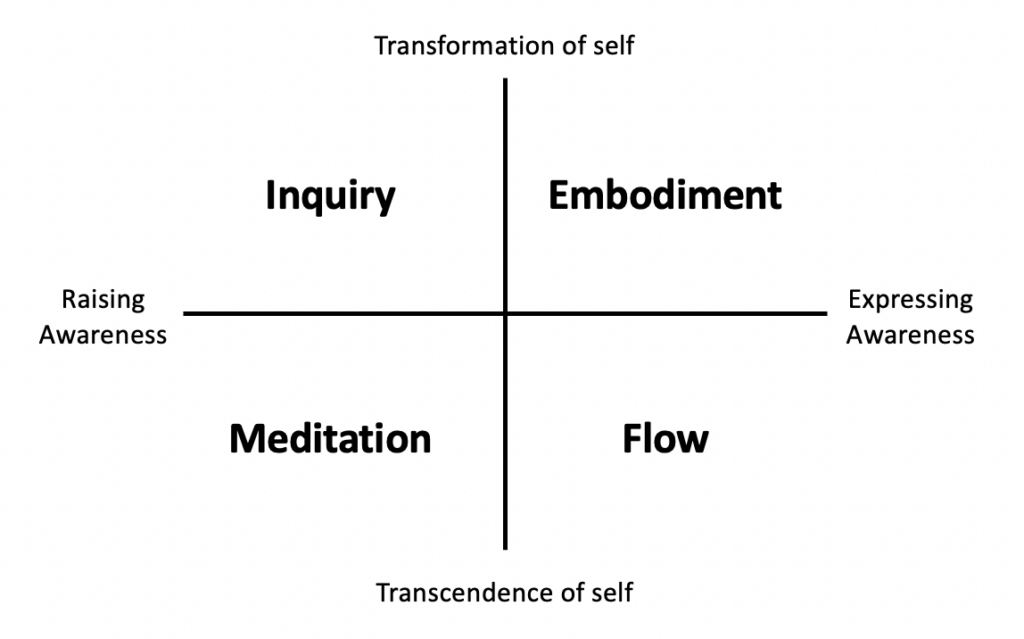
Being-Centred Living presents a rigorous system for personal and spiritual development consisting of four interlinked practices: Inquiry, Meditation, Embodiment and Flow, organised along the two axes of raising vs. expressing awareness and transformation vs. transcendence of self.

By combining these four practices, you can avoid the traps related to relying solely on one or two of these practices.

Practice 1: Inquiry

Inquiry is the practice of observing, without judgement or agendas, how your system of thoughts and emotions respond to various life situations – and to itself.

Without inquiry, you risk that the practices for spiritual and personal development you engage in become defences that prevents development rather than further it. You may, for example, start using meditation to avoid dealing with life – a phenomenon often referred to as “spiritual by-passing”.

Practice 2: Meditation

Meditation is the practice of unhooking your awareness from the turbulence of your system of associated and automatic thoughts and emotions.

Without meditation, it can be difficult to develop the capacity to choose a focus point for your awareness making other practices difficult as your awareness will be like a leaf in the wind.

Meditation is also the practice of savouring the peace, joy, love, energy, etc. of the present moment beyond the turbulence of thoughts and emotions.

Thus, spiritual and personal development without meditation is like sowing the seeds but never tasting the fruits.

Practice 3: Embodiment

Embodiment practice focuses on changing the way your concepts are grounded in felt sense and the body.

Without embodiment, you risk that the peace you find in meditation and other spiritual practices disappears the moment you get off your meditation coushin and start dealing with your daily business.

Practice 4: Flow

Flow is the practice of acting from the place of inner abundance that you find through inquiry and meditation and ground through embodiment. It is the action you want to take when you feel you no longer lack anything but act purely out of gratitude, curiosity and love.

Without flow, you will not develop the potential you were born with. Without flow, you will rob the world of your unique and precious contribution to the world.

Structure of the education

The education consists of four years, during which the student progresses from basic to advanced techniques and from exploring more surface to more core issues of human experience and well-being. 

Year 1: Essence of Life

Explores the four main tools of essence work (inquiry, meditation, embodiment, and flow) and how to apply these to working with six key domains of human experience: grounding/confidence, vitality/strength, peace/power, compassion/kindness, joy/happiness, and openness/freedom.

Modules

  • Module 1: On Support, Grounding & Confidence
  • Module 2: On Strength, Courage & Aliveness
  • Module 3: On Peace, Power & Stillness
  • Module 4: On Compassion & Loving-Kindness
  • Module 5: On Joy and Happiness
  • Module 6: On Freedom, Openness & Receptivity

Year 2: Essence of Love

Explores deeper layers of the main tools of essence work and how to apply these to working with six domains of love: appreciation, satisfaction, unity, passion, intimacy, and trust.

Modules

  • Module 7: On Appreciation
  • Module 8: On Nourishment, Satisfaction & Fulfilment
  • Module 9: On Sweet uniting and bonding
  • Module 10: On Passion
  • Module 11: On Intimacy
  • Module 12: On Basic Trust

Year 3: Essence of Perception and Self

Explores what we know about human perception and how this knowledge can be used to strengthen the four tools of essence work. We also explore the themes of self, identity and narcissism.

Modules

  • Module 13: On Clear Perception
  • Module 14: On Guidance
  • Module 15: On Contact and Maturation
  • Module 16: On Self and Not Self
  • Module 17: On Self and Narcissism, part 1
  • Module 18: On Self and Narcissism, part 2

Year 4: Essence of Emptiness and Totality

Explores two time-honoured spiritual paths of realisation: the emptiness of the inherent nature of all phenomena (emptiness) and the expansion of identification to include all phenomena (totality).

Modules

  • Module 19: On Emptiness, part 1
  • Module 20: On Emptiness, part 2
  • Module 21: On Totality, part 1 – Manifestation & Celebration
  • Module 22: On Totality, part 2 – Pleasure & Expression
  • Module 23: On Totality, part 3 – Totality & Greatness
  • Module 24: On Totality, part 4 – Generative Force & Truth

What people say about the course

Practical Information

Time: Each year consists of 24 3-hour evening sessions (CET)

Price: 29.500 DKK per year (approximately $ 4.280 / £ 3.380 / € 3.960)

Venue: All teaching will take place through live online sessions on Zoom

Teacher: Claus Springborg, PhD

About Being-Centred Therapy

To give an impression of what Being-Centred Therapy (BCT) is, it is useful to compare and contrast it with various well-known therapeutic approaches – in particular, cognitive-behavioural approaches, somatic approaches, and approaches based in humanistic and Buddhist psychology.

Insofar as BCT draws on modern cognitive science to develop therapeutic practices, it resembles cognitive approaches to therapy, such as Cognitive-Behavioural Therapy (CBT) and Neuro-Linguistic Programming (NLP). Cognitive approaches to therapy generally focus on challenging and changing cognitive distortions that prevent the client from solving problems and achieving desired goals. These approaches can involve varying degrees of working directly with behavioural patterns and with developing capacity for tolerating and regulating emotions. BCT differs from such approaches by emphasising and working specifically with the embodied roots of cognition – including the embodied states the client uses to formulate his/her problems and desired goals and to relate to his/her behaviours and emotions.

BCT works with the embodied roots of cognition through attention to the client’s “felt sense”. This gives SLP a close affinity with Eugene Gendlin’s Focusing approach to therapy. In the 50s and 60s, Gendlin conducted seminal research under the supervision of Carl Rogers, a founder of humanistic psychology. This research showed that success in therapy depended on clients’ ability to access the nonverbal, somatic felt sense of the issue they worked with. Gendlin’s research has since inspired a wave of somatically focused approaches to therapy, for example, Peter Levin’s Somatic Experiencing. In BCT, felt sense is used not only to address specific problems and traumas, as in Focussing and Somatic Experiencing, but more importantly to bring about a fundamental shift in the totality of the clients’ way of experiencing self and life by working with the somatic ground of the client’s cognitive processes.

In particular, BCT is concerned with bringing about a fundamental shift in how we perceive phenomena in the world, which will dissolve many of the specific problems human beings face in their lives. In this way, BCT has an affinity with Buddhist psychology. Like in Buddhism, it is assumed that the majority of our suffering in life is produced by a fundamentally flawed way of perceiving reality. Buddhists claim that our suffering arises when we fail to see that phenomena are empty of inherent existence. Drawing on research in embodied cognition, BCT elaborates by saying that our suffering or discontent arises because we do not see our own participation in the creation of the phenomena we deal with in everyday life and because we use the somatic states of grasping or pushing away physical objects to understand our interactions with both ourselves and the world.

In BCT, the client is invited to explore the embodied essence of key positive phenomena that the client desires, and that drive most of his/her behaviour, for example, happiness, sense of purpose, peace, aliveness, strength, commitment, compassion, freedom, and love. This exploration leads to the gradual realisation that these phenomena are aspects of the present moment as it can be experienced before any agenda is applied – and not something we need to struggle to acquire. This realisation emerges out of the therapeutic process, not as a mere theoretical understanding, but as a lived experience. When this happens, it calms the client’s compulsions and anxieties, dissolves the client’s sense of deficiency, and connects the client with his/her inherent sense of resourcefulness, satisfaction, and sense of purpose in life. When clients feel that the present moment is always pregnant with everything they seek, it becomes possible for them to select and achieve goals in a more spontaneous and effortless manner. They will be motivated in their actions by an inner sense of abundance that overflows, rather than by an inner sense of lack needing to be filled – what Abraham Maslow called abundance motivation.

In BCT, the client is also invited to explore the embodied essence of the thoughts, emotions, and instinctive urges that he/she perceives as undesirable and wishes to get rid of, limit, control, or change. This exploration leads to the gradual realisation that there is nothing in us we need to reject, since everything in us, no matter how it may appear at first glance, is ultimately nothing other than an energetic movement towards the above-mentioned states of happiness, sense of purpose, peace, aliveness, strength, commitment, compassion, freedom, and love. The practice of skilfully connecting with and riding the energetic wave of any internal movement – whether we perceive it as good or bad – is a powerful way of becoming aware of the present moment before any agenda is applied and developing the compassionate and loving way of perceiving life that Ann Weiser Cornell, a prominent student of Eugene Gendlin, beautifully describes as: the radical acceptance of everything.

In short, BCT is a system of explorations using inner felt sense to correct the cognitive flaws that lead human beings to pursue courses of action hoping to attain happiness and similar states while unknowingly creating and sustaining their own suffering in the process. Engaging with BCT has a twofold effect. First, you realise that all you feel you lack is present to you at every moment. Second, the somatic ground of your concepts will be redefined in ways that allow you to live life from a place of inner abundance and compassionate understanding.

About Claus Springborg, PhD

Over the last couple of decades, I have studied various traditional and contemporary paths of personal development. In particular, I have studied the Enneagram with Claudio Naranjo, Tibetan Buddhism with Chökyi Nyima Rinpoche, and the Diamond Logos essence work with Faisal Muqaddam, Jeremy Klein, and Velusia Van Horssen. I also hold a master practitioner degree in NLP.

I did my doctoral research at Cranfield University, UK. I researched how I could use modern cognitive science to understand the practices of personal development I had learned from the above-mentioned masters. In particular, I used cognitive metaphor theory and theories of embodied cognition. Sixty managers from various organisations participated in the research. The research is published in the book Sensory Templates and Manager Cognition: Art, Cognitive Science and Spiritual Practices in Management Education and in several book chapters and academic papers on topics, such as education, therapy, cognitive science, leadership, and community building.

Today, I have established a school, Sensing Mind Institute, where I teach my methods of personal development to therapists, psychologists, counsellors, managers and others who work professionally with people. Apart from my work with Sensing Mind Institute, I am lecturing on leadership, entrepreneurship, community building, and co-creation at Copenhagen Business School and at The Royal Academy of Music in Copenhagen.

I have a background in music, dance, and physics. In my teaching, I emphasise kindness, precision, and humour.

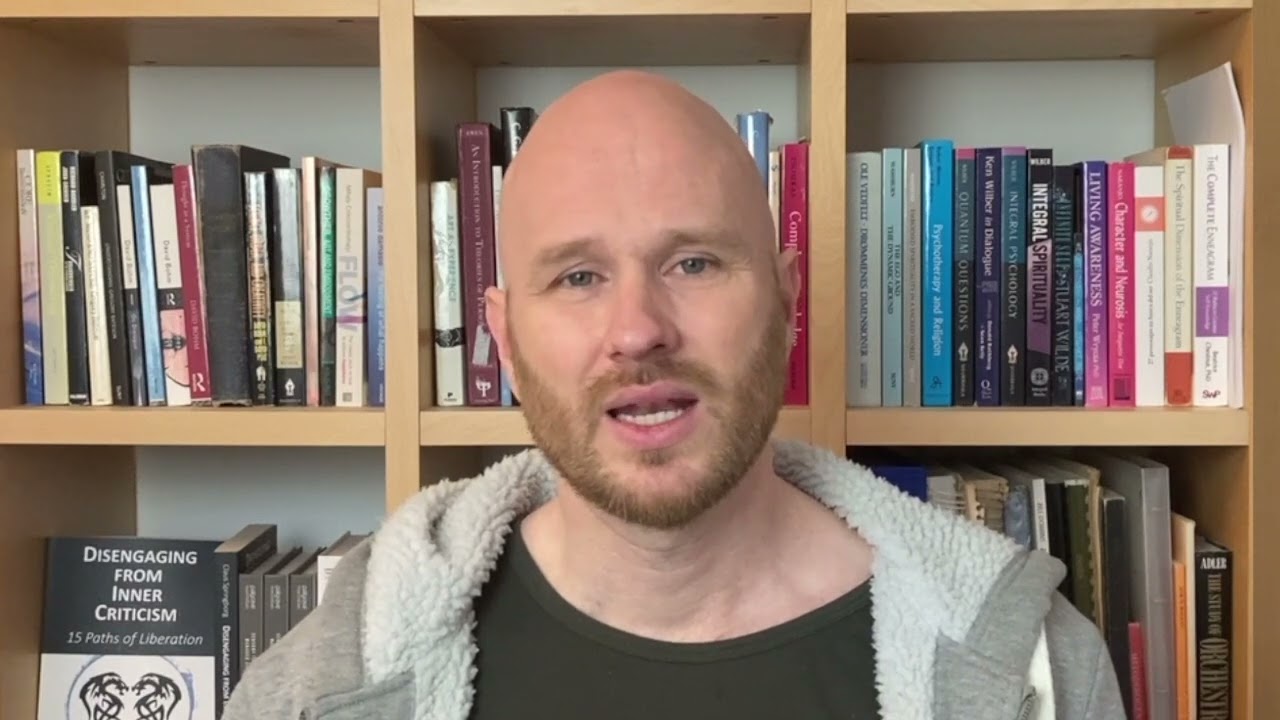
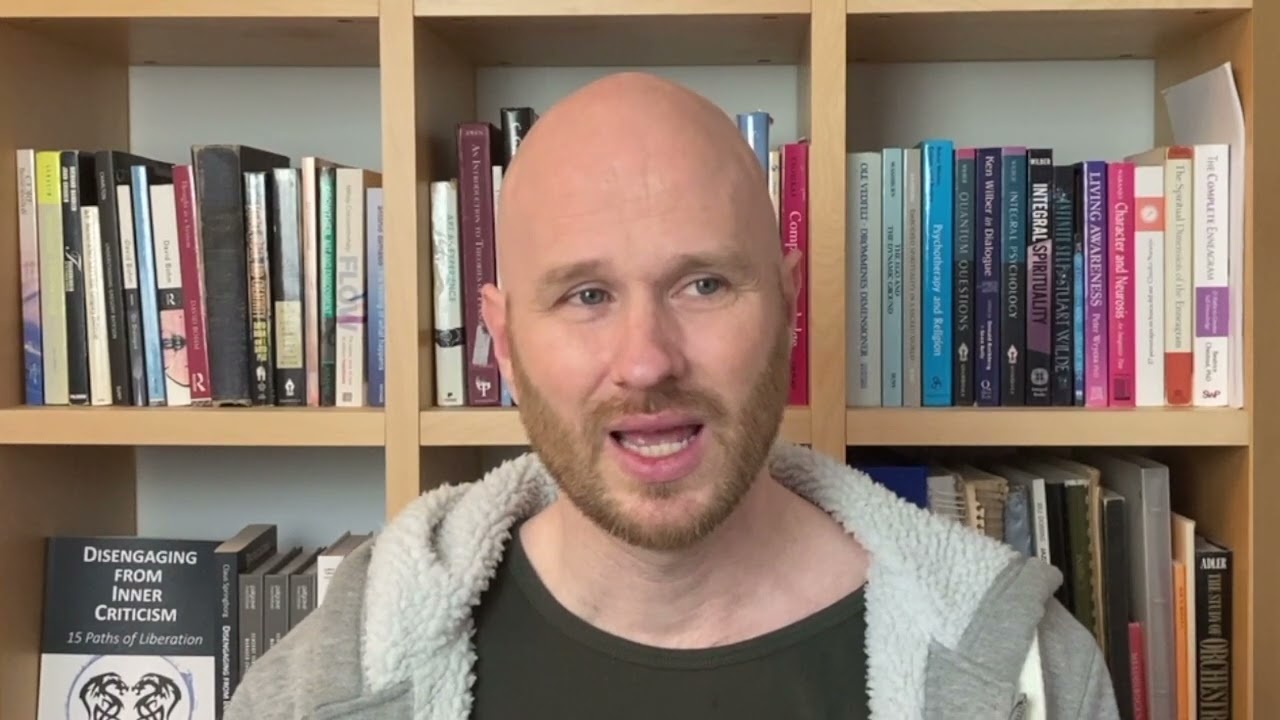
Claus talking about the first year of the education

Essence of Life